News
Jumia 2Q 2026 Earnings Delivers Major Endorsements
August 18, 2026Company News
Summary
- Jumia Technologies secured a $50 million investment led by IFC, strengthening its balance sheet and validating its strategic role in African digital commerce.
- Jumia maintains a strong buy rating, citing resilient demand, operational improvements, and analyst consensus despite recent stock volatility and lowered GMV growth guidance.
- Profitability targets remain intact: Q4 2026 breakeven on adjusted EBITDA and positive cash flow, with full-year 2027 profitability expected, supported by cost discipline and margin improvements.
- AI-driven efficiencies, diversified supply, and focused marketing are enhancing Jumia’s competitive positioning and structural health, even amid supply chain and macroeconomic headwinds.

A Financing Round with A Strong Message
Jumia Technologies AG (JMIA) took another big leap forward in demonstrating its long-term potential. As a part of Q2 2026 earnings results, the company announced a $50 million combined investment anchored by $25 million from the International Finance Corporation (IFC), the private sector arm of the World Bank Group, AXIAN, Jumia’s largest shareholder, and other private investors. The company indicated this investment strengthened the balance sheet and provided funds to invest in future growth initiatives. The investment also signaled confidence in the company’s future from a highly regarded investor in growth in low and middle-income countries. The IFC’s heralded position in global finance means that Jumia joins a portfolio tuned for economic prosperity. In my interview with CEO Francis Dufay, he emphasized that “in our countries, it’s a big deal.” Investors in emerging and frontier markets know the IFC and like to invest alongside the organization. The IFC de-risks projects.
Moreover, the IFC stamp of approval carries weight with local governments and regulators. Dufay noted that IFC teams can help in interactions with public authorities. According to Dufay, the IFC is “possibly the best investor we can think of when you’re a public company operating in Africa.”
The rigorous due diligence conducted by the IFC acts as yet one more endorsement and validation of Jumia’s prime position in the future economic development in African countries. Dufay described the effort with IFC as “a lot of work.” That work is a crowning symbol of the diligence Dufay and team have exerted to create a firm foundation for Jumia. Accordingly, JMIA has easily become one of the most undervalued and underappreciated companies that I write about and invest in.
The International Finance Corporation: A Highly Regarded Investment Arm of the World Bank
Before I move on to cover my latest interview with Dufay and Jumia’s earnings results, I want to explain the importance of the IFC.
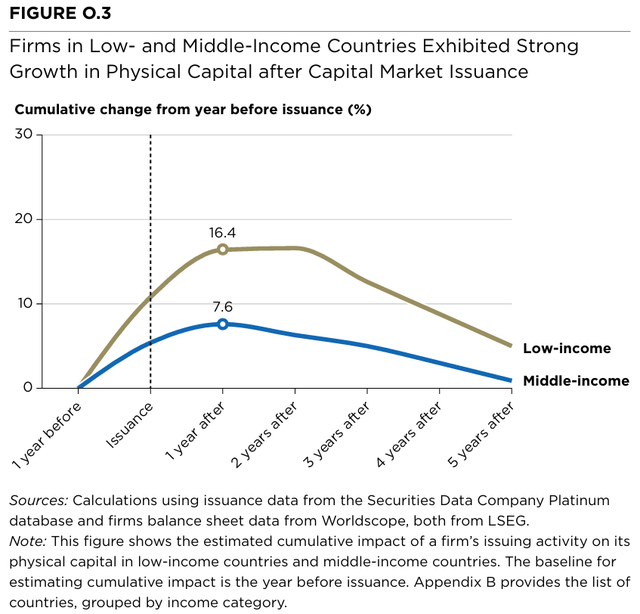
The IFC describes itself as a pioneer in impact investing that encourages the growth of the private sector in developing countries. These investments target poverty reduction and sustainable development. The IFC typically invests in a sizable portion of a company from 5% to 20% (the combined $50 million investment is almost 7% of Jumia’s market cap). The IFC’s commitment to capital markets as an engine of economic prosperity is grounded in a 2025 report showing how “equity and bond markets foster growth in developing economies, contributing $4 trillion in capital and generating 5 percent more jobs over three decades.” Portending well for Jumia, this report concluded that “deeper capital markets channel more investment toward productive firms, helping them expand and fueling development.” This description fits Jumia’s profile.
The chart below summarizes how capital investment sparks incremental growth:
IFC’s press release about its equity investment in Jumia is telling and consistent with the organization’s investment philosophy and objectives. The IFC announced its Jumia investment supports the expansion of digital commerce infrastructure in Africa with real economic impact:
“Investment will help approximately 60,000 local annual active sellers reach broader markets while supporting around 1,800 direct jobs and income-generating opportunities for more than 100,000 independent sales agents.”
This official recognition aligns with one of my original investing interests in JMIA. The IFC also recognized Jumia’s role in providing access to online marketplaces, logistics networks, and digital payments. This access is “increasingly important for entrepreneurs and small businesses seeking to expand beyond local markets.” In other words, Jumia is part of a strategic lever of economic development in Africa.
Investing the Capital Raise
In our discussion, Dufay indicated that Jumia will use the extra funding to increase the allocation of working capital to secure more supply in the second half of the year. Despite the volatility and uncertainty created by tariffs and the war against Iran, underlying demand fundamentals remain strong across Jumia’s markets. Thus, the company has solid reason to keep apace with supplies for its markets. These plans are also a strong signal of expectations for another successful Q4 shopping season.
Dufay also pointed to plans to judiciously allocate capex to “improve our fulfillment efficiency, mostly warehouse automation and warehouse equipment.”
Overall, Dufay is looking forward to having more freedom in 2027 to drive growth and leverage marketing. For Q2, the company announced a 33% year-over-year increase in sales and advertising, up to $5.5M. Over the last few quarters, the company has described plans to increase marketing in focused and strategic ways. During the earnings conference call, the company described plans to scale “high ROI marketing investments on the back of stronger product fundamentals, improved quality of service, and higher platform reliability.” This approach sharply contrasts with the marketing Jumia conducted before Dufay’s tenure; at that time, the company spent a lot of money on low-return marketing like promotions with substantial discounts.
Holding the Line on Profitability
The stronger product fundamentals were not as clear as usual because of pressures on GMV in Q2.
The earnings release described a convergence of pressures: “supply headwinds in higher value categories, specifically phones and electronics, inflationary pressure from fuel prices across markets, and softer demand in Ivory Coast following the decline in cocoa farmgate prices.” These pressures produced lower than expected GMV (Gross Merchandise Value) and drove a reduction in full-year GMV guidance.
Jumia delivered 23% GMV year-over-year growth, below prior expectations for 27% to 32%. Accordingly, the company also lowered full-year guidance from 27% to 32% year-over-year growth to 20% to 30%. The wider range for GMV growth represents the increased economic uncertainty.
Yet, the company maintained its profitability and cash flow positive targets. Jumia projected Q4 2026 breakeven on an adjusted EBITDA basis and positive cash flow. Fiscal year 2027 will still deliver full-year profitability on an adjusted EBITDA basis and positive cash flow.
A combination of ongoing cost reductions and retention improvements is keeping the company on target. The supply impact on lower-cost smartphones created a positive mix effect on margins, given offerings like home living, fashion, and accessories provide higher take rates.
According to Dufay, Jumia is also benefiting from operational leverage “because we were able to increase the take rate and further reduce unit costs across the P&L.” For example, adjusted EBITDA loss declined by 36% to $8.7M, down from $13.6M a year ago. The continued progress toward profitability confirmed that Jumia is not chasing GMV at all costs, even when certain categories are facing temporary pressure like the low-end cell phones. Dufay emphasized, “That's not the plan…launch additional discounts or more marketing or put more money into the other categories to make up for the loss in some other categories.”
Fortunately, strong underlying demand showed up again in the count of active customers and the growth of physical goods orders. Quarterly active customers reached 2.6M with 23% year-over-year growth versus the 12% year-over-year growth a year ago. Physical goods order growth increased 28% year-over-year compared to 19% growth a year ago.
These demand dynamics help Jumia maintain its guidance on profitability.
Built for Market Shocks
Like the rest of the market, Jumia does not yet foresee improvement in the supply of memory chips that’s impacting low-end phones. According to Dufay, “Phone brands are discontinuing the entry-level models, and they’re allocating the few chips they have to the more premium phones.” This choice for profitability means less supply for Jumia’s customers and will inflict a drag on GMV. In the meantime, pent-up demand will build for the lower-end phones, and normalization, whenever it happens, will unleash a surge in GMV for Jumia.
Fortunately, Jumia is now a company hardened and built for market shocks. Dufay described how well the company is prepared to handle these kinds of shocks, especially compared to a few years ago. Now, Jumia is a well-diversified company with “strong growth engines in many categories, many countries.”
During the conference call, Dufay noted that “while we are currently navigating an uncertain international environment, we believe that our business fundamentals, which were rebuilt from ’22 to ’25, mostly in tougher times than this, are strong and resilient.” During our discussion, Dufay elaborated to say that Africa was written off after the start of the war against Iran, and instead, African markets have proven resilient. That resilience translates to Jumia’s resilience.
Even with the market shocks, Dufay sees an economic environment that is much healthier. Stabilized exchange rates are the most prominent example of the improvements. For example, Dufay observed that fuel prices soared in Nigeria by 40%, yet Nigeria still grew GMV by 36% year-over-year.
Jumia’s value-oriented platform is particularly attractive during times of market shocks.
Structural Health
The stronger product health fundamentals showed up in ongoing improvements in the structural health of the company. Per the Q2 earnings presentation:
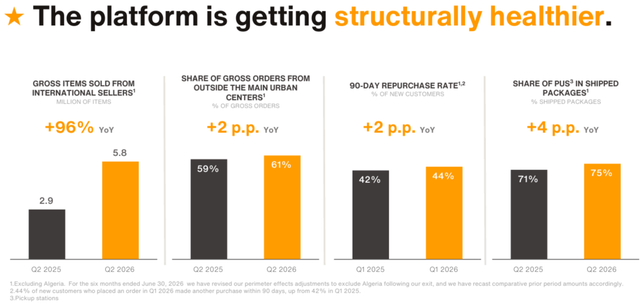
Dufay explained that the surge in the share of gross items sold from internal sellers demonstrates “our ability to grow our international supply base.” This metric showed that Jumia is able to access international supply to scale faster.
The increase in share of gross orders from outside the urban areas demonstrated the ongoing success of Jumia’s expansion strategy.
The two percentage point increase in the 90-day repurchase rate was particularly notable as confirmation of structural health and strong underlying demand. Jumia continues to attract new customers who return to buy more products.
The increased share of PUS (pick-up stations) in shipped packages is a testament to Jumia’s strong logistics and efficient delivery model.
Competition
Dufay said that the “intensity of competition has barely changed.” This claim was good to hear given the current market shocks. Dufay described Amazon and Noon as competitors targeting the upper middle class with fast delivery for groceries. Not only did Jumia exit the grocery delivery business some time ago, but the company is also targeting a different market in Africa’s lower middle class, who are value- and price-conscious consumers.
Temu is currently active in Ghana, Nigeria, Egypt, and Morocco. Morocco is small, and Nigeria is the big prize. In Q2, Dufay saw “nothing meaningfully different from Q1.” However, there was a big spike in search traffic in Nigeria that was hard to explain until a local Jumia team uncovered viral hype in Nigeria about how to take advantage of Temu vouchers and free shipping. According to Google search trends, “Temu flash grab code” is a rising query. Of course, Jumia stays away from such resource drains.
The chart below from Google search trends shows that this viral phenomenon sent Temu’s Google search activity above Jumia’s for the first time. (The spike started July 8 and peaked 8 days later).
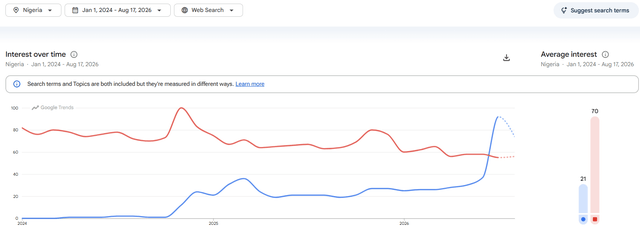
I have described in previous Jumia articles how these Google search trends can reveal important competitive dynamics. These kinds of spikes reveal the willingness of the competition to try to buy its way into Jumia’s markets. So far, these efforts continue to fall short.
Innovation with AI
Increasingly, Jumia’s competitiveness is coming from innovation.
The nonstop push for efficiency has recently extended to using AI-driven workflows across the company. Existing staff are accomplishing this work, but Jumia now has a formal governance team that oversees the costs of AI (artificial intelligence) projects. Functions are building AI projects in a coordinated fashion. Once there is a clear proof of concept, the project is moved to the roadmap for the tech team to turn into tools and integrated into the company-wide tech stack.
Dufay offered one particularly striking example of AI-driven efficiencies related to content review. Jumia has a long list of guidelines for vendors creating content on the platform for selling products. The company previously had to sample the vast amount of content for its quality assurance process. Now, AI can handle QA of all content. AI is particularly useful and applicable for structured rules and semi-structured data like marketing copy.
Jumia’s drive for innovation is like an open road. According to Dufay, “We keep on discovering new opportunities to become more efficient in many departments and teams…one month from now we’ll have new opportunities that I cannot even think of today.” As a result, Jumia has continued to reduce staffing costs. At some point soon I want to see this good operational news transform into increased hiring due to innovation-led expansion of revenue-generating opportunities. Such an achievement would provide a very constructive growth signal. That is, today’s efficiencies should build the solid foundation from which Jumia can extend growth in even more productive ways.
Conclusion: The Trade
Jumia gained 10.5% after reporting earnings the morning of August 12. However, the stock is still down 49% for the year. The stock has yet to recover from investor disappointment after Q4 earnings. Q1 earnings generated a lot of excitement, but traders erased the 16.8% post-earnings gain within days. This trading action left Jumia tentatively bouncing off its 52-week low ahead of Q2 earnings, a level last seen in the wake of Q2 2025 earnings when the company increased guidance for that year.
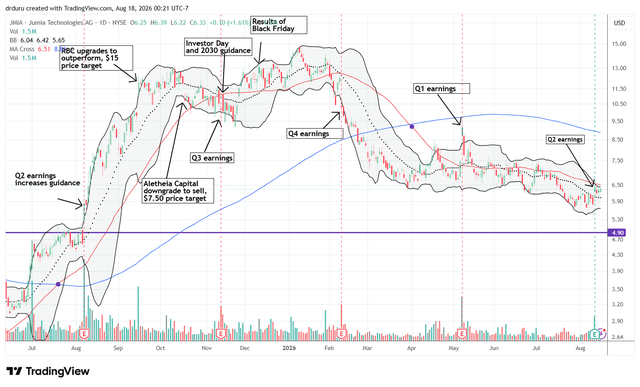
This volatility is misaligned with Jumia’s business performance and prospects, making Jumia, at current prices, about as attractive as ever. Jumia traded at almost double current levels when it released its 2030 plans, and nothing fundamental has changed since then. Accordingly, I am maintaining a strong buy rating on Jumia; I also accumulated shares in recent months.
As partial validation of my ongoing bullishness, Jumia is attracting more and more analysts, and all five are bullish. Wall Street analysts rate JMIA with 4 strong buy ratings and 1 buy rating. Price targets range from a modest $7.76 to a lofty $17.98. Perhaps this coming November, another Investor Day will reverse market sentiment and reawaken broader buying interest to accompany the major endorsements from Wall Street analysts, the IFC, AXIAN, and other institutional investors.
Be careful out there!
Read the original article on Seeking Alpha
About Jumia
Jumia is a leading e-commerce platform in Africa. Our marketplace is supported by our proprietary logistics business, Jumia Logistics. Jumia Logistics enables the seamless delivery of millions of packages.
Follow us on, Linkedin Jumia Group and X @Jumia_Group
For more information about Jumia:
Abdesslam Benzitouni
[email protected]