News
Jumia Technologies Q3: Untimely Resurgence Of Macroeconomic Pressures (Seeking Alpha)
November 24, 2026In the News
Summary
- Jumia Technologies (JMIA) is a true Hold: the operating model remains solid, but macroeconomic pressures and uncertain 2027 guidance leave the stock in limbo.
- JMIA cut 2026 GMV growth guidance to 16%–18% and expects a $31 million–$35 million adjusted EBITDA loss after a weak start to Black Friday sales.
- Q4 positive cash flow remains expected, but inventory drawdown depends on demand; 2027 profitability and cash flow guidance awaits an update after Q4.
- I see little reason to buy before guidance clears, but no reason to sell into panic; operating leverage and growth initiatives support long-term confidence.

I have interviewed Jumia Technologies (JMIA) CEO Francis Dufay for over three years. I have followed the company even longer. The experience has been a roller coaster requiring focus on the company’s long-term potential while carefully managing short-term risk. Dufay made thatfocus easier with a successful turnaround strategy and a plan that created a resilient enterprise built for growth. Yet, this latest swoosh down the elevator of a tough operating environment is the deepest test yet of my bullish thesis. Perhaps only the “primal panic” two years ago in the aftermath of a stock offering rivals the market’s latest crisis of confidence in the company and the stock.
The technicals on JMIA’s price action turned bearish after the stock’s 16% post-earnings plunge following Q4 2025 earnings. That selling soon turned into a price breakdown below its 200-day moving average (DMA), a critical long-term trend line. That failure was the market’s expression of doubt and skepticism in the company’s 2030 vision. The company’s leaders made a compelling case for this vision just three months prior to the price breakdown. The stock's path to recovery got extremely challenging with the 40.8% post-earnings loss and 18-month low.
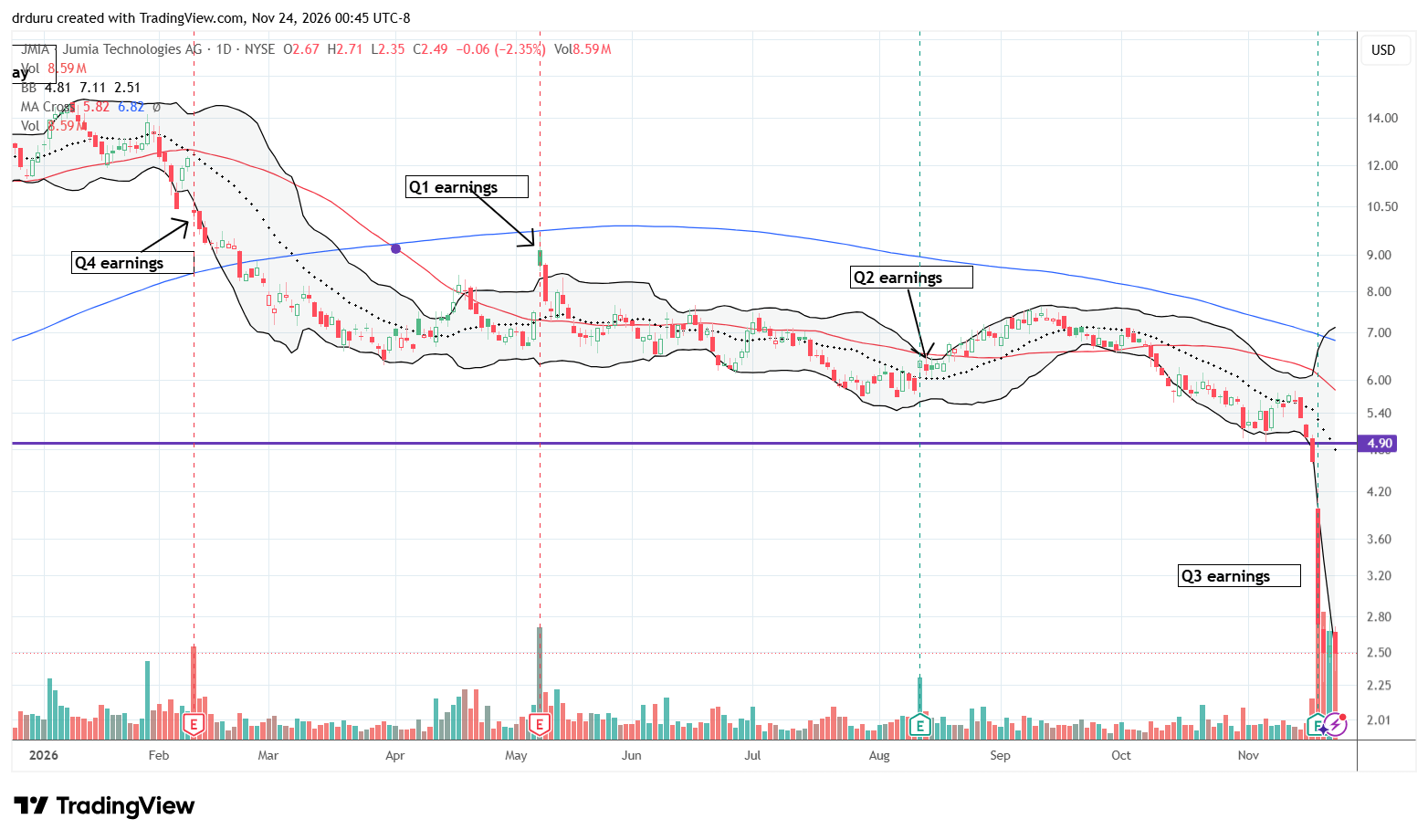
Yet, along the way, JMIA’s 2026 Q1 and Q2 earnings results delivered timely and convenient reminders of the company’s growth engine. August’s major endorsement and investment by the International Finance Corporation (IFC) and AXIAN provided a refreshing counter to the stock’s poor price performance. Yet, the macroeconomic environment delivered a 1-2-3 punch that made its impact felt in Q3. Persistently high oil prices due to the war against Iran, an AI infrastructure buildout that catapulted memory prices out of reach, and a catastrophic cocoa season in Ivory Coast that slashed farmer incomes all combined to force Jumia to reduce Q4 guidance in its Q3 earnings report. The stock’s resulting collapse likely reflects renewed wariness about the profit milestones for 2027.
This shroud of negative catalysts did not seem to dampen Dufay’s mood. He sounded resolute in declaring that “what I am telling the teams is that we should stay focused and we have quite a big roadmap to deliver so we can revive the flywheel.” This is the determination that I expect, and one of the main reasons I am sticking by Jumia the company and the stock.
Guidance
The lowered Q4 guidance seemed to overwhelm the entire earnings report. Due to the lower Q4 guidance, Jumia reduced 2026 full-year guidance as follows:
- GMV growth (%): +16 to +18 from +20 to +30
- Adjusted EBIDTA ($M): -31 to -35 from -25 to -30
Despite the hit, Jumia surprisingly still expects to achieve positive cash flow in Q4.
Dufay stepped through the mechanics one by one. He started by pointing out that the company expects “significant working capital impacts in the last quarter….that will offset the EBITDA loss.” The working capital that went into stocking ahead of promotional events will get drawn down in Q4. This upside of course relies on Q4 demand. Since reduced Q4 guidance did not directly take down expectations for Q4 positive cash flow, I have to assume that Jumia baked some wiggle room into its original forecast. The outstanding question of concern is whether the updated guidance still leaves sufficient wiggle room.
Because Jumia offered no update for 2027 and instead deferred an update to follow Q4’s completed financial performance, investors and traders are free to imagine the worst case scenarios. The previous fiscal 2027 guidance was for full-year profitability on an adjusted EBITDA basis and positive cash flow which removed questions about the viability of the company’s balance sheet. The aggressive post-earnings selling suggests that concern is back on the table for market participants.
In explaining the changed outlook, Dufay pointed to a surprisingly poor start to this year’s Black Friday season. For Jumia, Black Friday is a one month sales event that started October 30 this year. Dufay explained that “in the first few days we noticed something was off in the trends and well below expectations.” The spike in demand that Jumia experienced at the beginning of 2025’s Black Friday “failed to materialize this year” according to Dufay. While all the macroeconomic pressures that pressured Black Friday were already discussed in previous earnings reports, the impact was still much larger than anticipated.
This episode is a reminder of the volatility in the macroeconomic environment and the resulting risks inherent in Jumia’s stock.
Operating Leverage
The good news is that the core of Jumia’s operating model remains strong. As shown below, Jumia continues to record strong improvements across the components of profitability. The accompanying list of operational improvements demonstrates an on-going commitment to continual improvement.
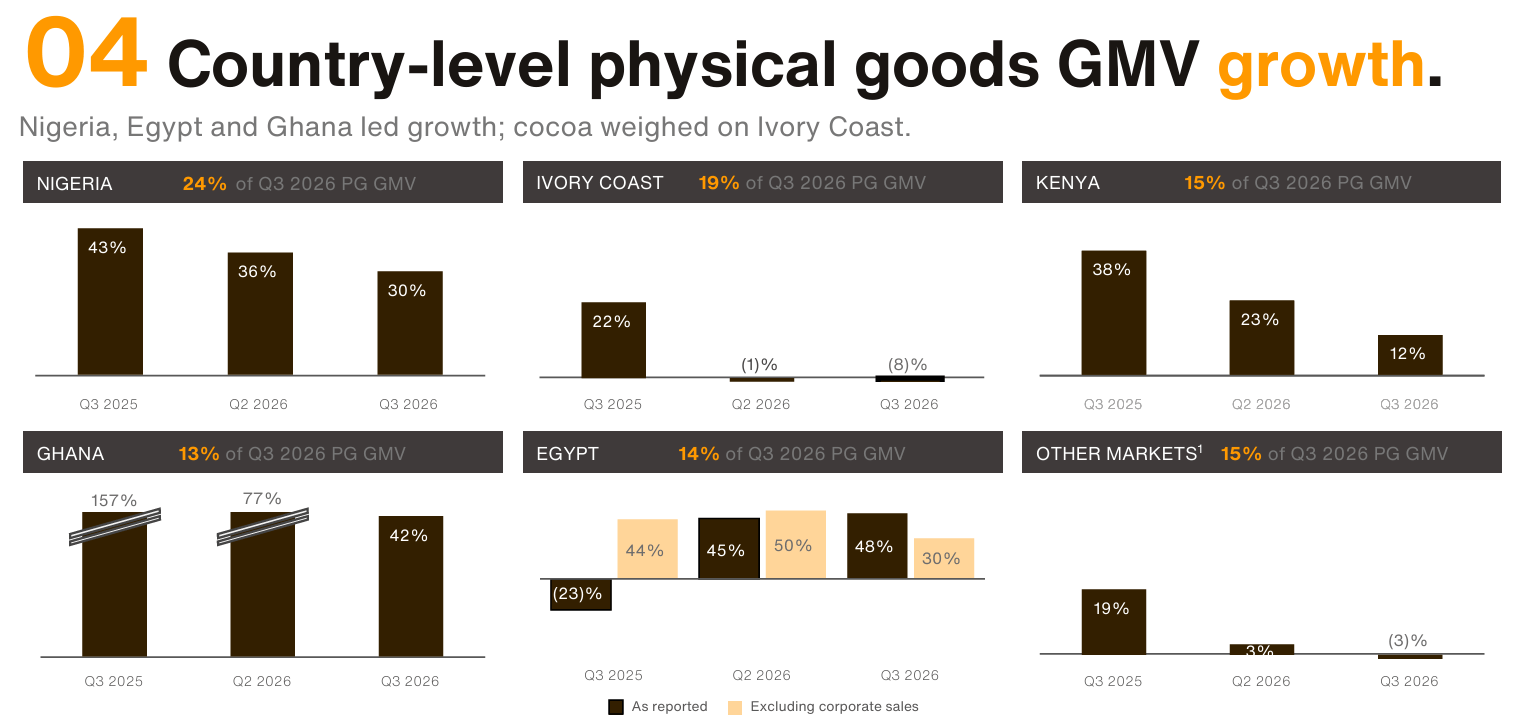
Without this strong engine, Jumia would be much more vulnerable to macroeconomic headwinds.
Asymmetric Risks from the AI Infrastructure Buildout
The price pressure impacting African consumers from the memory shortage is about as exogenous as it gets. This kind of risk is difficult to work around in a market reliant on lower priced goods. Apparently, the runway ran out for downgrading phone selections, a coping strategy that worked earlier this year.
The AI infrastructure build-out has created this global shortage in memory, resulting in a cascade of price effects across electronic goods. According to Dufay, affordable mobile phones, laptops, and smart TVs have declined. For example, according to Omdia (TTGT), a market research firm, shipments of smartphones to Africa plunged by 40% year-over-year in Q3. Shipments of low-end smartphones, those priced under $100, fell even further at 70% year-over-year. For the year, Omdia expects smartphone shipments in Africa to drop 23% year-over-year and worsen slightly in 2027 to a 25% year-over-year decrease. This sustained slowdown represents a significant headwind for Jumia even though the company is still outperforming the market according to Dufay.
Thus, seemingly, African markets are not only benefiting little from the buildout, but actually being hurt economically. Dufay offered a positive counterpoint for Jumia’s business. He pointed out that “we are able to automate some tasks” as AI adoption has lowered the cost base and improved operations. He continued, “I anticipate the biggest transformations will come from AI-driven topline improvements…SEO [search engine optimization] with AI search will become an important marketing channel” given emerging market users have become pretty good users of ChatGPT for research and shopping. The uplift “is not meaningful yet and there is no specific timeline for that growth’ Dufay noted, but it should be “soon.”
AI is also helping Jumia to “develop new products, much faster.” For example, Jumia is launching a new affiliation platform that “enables product developments in a few weeks or months rather than a few years.” Affiliates are currently a much bigger deal in developed markets, and thanks to AI, Jumia can more readily develop them for its markets.
I am looking forward to AI becoming a transformative tool on the top line. Ultimately, the most successful businesses should be those that innovate new market opportunities with AI and not those that just shrink their cost base with AI.
Fulfillment Expenses
Jumia embarked on a journey to control its cost bases as soon as Dufay took on the CEO role. Yet, fulfillment expenses increased 19% year-over-year in Q3 (11% in constant currency). This follows an 18% year-over-year increase in Q2 (21% in constant currency). The earlier increases were part of planned investments. For this quarter, Dufay explained that “for the people working in the warehouses, we had to deal with several mandatory minimum wage increases.” Elevated oil prices added a second cost pressure given ongoing fuel surcharges.
I know Wall Street tends to agitate about increased benefits to workers because they pressure margins, but I appreciate a company that can afford to pay its workers higher wages. As usual, higher wages motivate further efficiencies. For example, Dufay issued a reminder that “we are working to further improve efficiency and productivity in our warehouses, so we can offset the impact of wage increases.” The teams are getting better tools and apps to increase precision and quality. The fuel surcharges will remain for an indefinite amount of time but will create cost relief whenever the oil market returns to something resembling normal.
Country-Specific Drivers
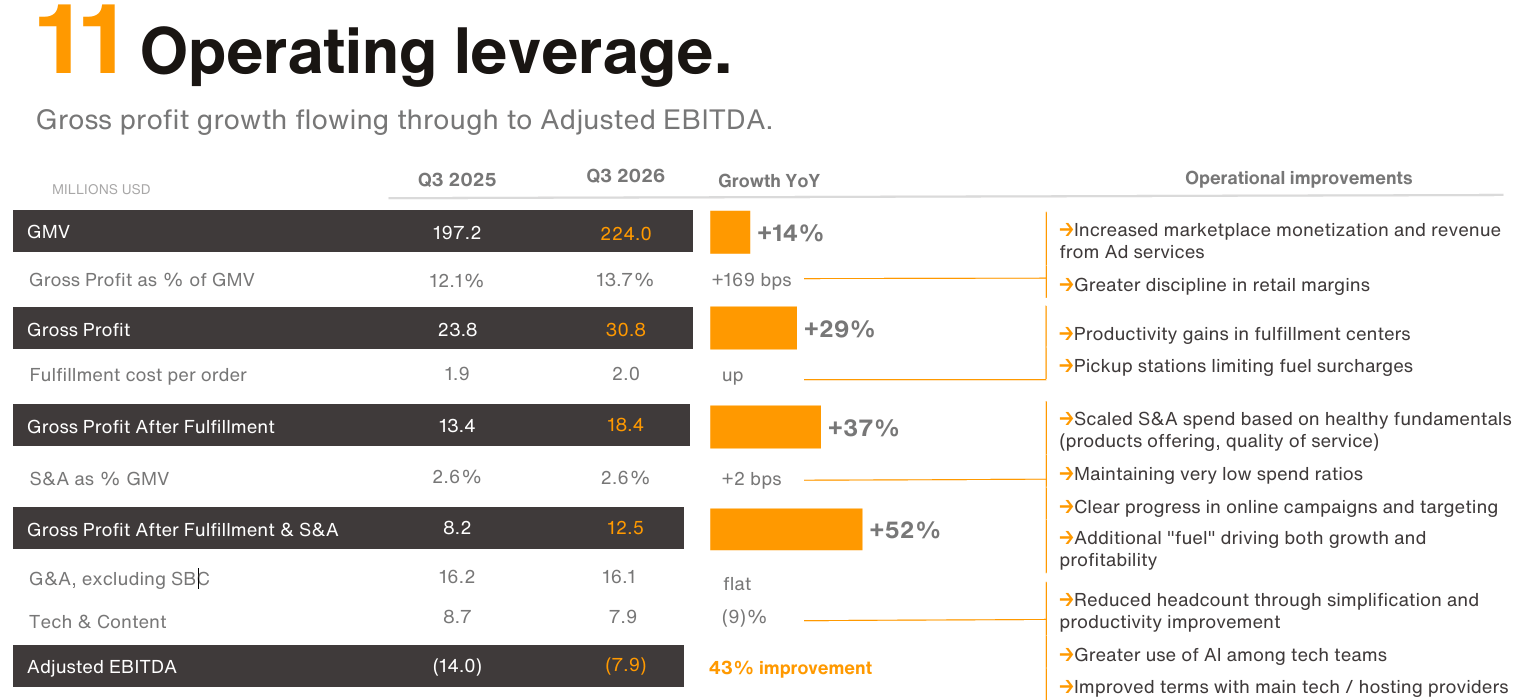
For now, there is “a net benefit to the Nigerian economy”, according to Dufay, from higher oil prices given the new Dangote refinery and a stable currency. Unfortunately, Jumia’s customers “are paying more for transportation and electricity. That’s the only thing our customers can see in the short-term.” Dufay further emphasized that “the national economy is holding on pretty well compared to the past, but there is a lot more pressure on consumers.” However, Dufay reassured, “the growth rates in Nigeria remain healthy.” One of the key takeaways from the earnings report was the 30% year-over-year growth in Nigeria’s GMV (gross merchandise value).
Nigeria is a country that can be hard to fathom. You do not have to go far to see people struggling to make it day-to-day and also nearby are throngs of people who are thriving. The country is a place where people somehow find a way to make things work. One cousin’s clothing store in Abuja (the country’s capital city) has not registered a single sale in two weeks. At the same time, another cousin is soon getting married with all the traditional trappings; no slowing down. The simultaneous truths of struggle and triumph make for a volatile market, but I take my cues from the future potential.
Ghana’s growth rates also remain high. The triple digit growth rates of course could not be sustained, but at 42% year-over-year growth, Ghana remains one of Jumia’s fastest growers. This past quarter, Dufay noted that “Ghana sold its cocoa harvest at a much better time than Ivory Coast, at a much better price.” That fortune is also a win for Jumia’s customers. However, with growth normalization underway, I am looking for some stabilization not much lower than current growth levels in order to boost 2027 prospects.
Ivory Coast ran into trouble with cocoa and directly weighed on Jumia’s expectations. Dufay took time to explain the economic dynamics given Ivory Coast’s central importance to Jumia. Lower prices, smaller crops, and a later harvest could translate into income shrinking to one-third its normal size in the Ivory Coast countryside in Q4 according to Dufay.
The government’s low price to farmers apparently surprised everyone. The government unfortunately sold its last harvest at trough value in March. For perspective, Dufay observed that “Ghana offered a price 70% higher to its farmers” than Ivory Coast offered to their farmers. These price disparities often drive smuggling from the lower-price market of Ivory Coast to the higher one in Ghana. This transfer has the ironic and conflicting effect of improving economic conditions in the countryside while reducing the government revenues needed to support the economy. It is hard to say how this will all shake out but previous episodes have created persistent issues.
A Path Forward
Despite all these issues, Dufay declared that “there is plenty we can do on our end.” For example, increase the value proposition by “removing friction and create more ways to make money that will not cost meaningful amounts of money.” The priority is on acquisition and reengagement. Affiliates are the next big growth opportunity for Jumia. In an effort to expand the customer base, the company is also working on reviving mass media channels which Dufay said in the conference call are “channels that we have not really tapped over the past year, 1.5 years.” Optimizing marketing channels can be done for minimal cost or even lower cost using the large amounts of data Jumia collects. The company is also launching a project to optimize onsite conversion on the B2C side that “hasn’t been upgraded in a long, long time.” All these initiatives are encouraging and necessary in order to increase the company’s resilience in the face of persistent macroeconomic challenges.
Jumia has also turned its attention to reducing friction, removing complexity, and lowering entry barriers for its pickup stations and Jumia Force (JForce) partners. The company is upgrading the business model on the operational and product side and reducing the amount of capex required for getting in the business. For example, Dufay noted that pickup stations “can run their business on a smartphone…removing $300 or $400 of capex.” JForce agents will also get an easier to use app and more ways to make money, like through affiliations that help increase reach. Thus, the bar is lowering for making money, creating more incentives for JForce agents.
In coming quarters, I will be looking for specific data and metrics on the success of these initiatives.
The Capital Raise
The earnings report disclosed Jumia’s use of the $45.6M in net capital that it raised in August, 2026. This money is in a brighter spotlight given the reduced guidance and current uncertainty about 2027 financial performance. Here is the list of expected uses:
- Securing attractive supply opportunities: Deploying working capital to broaden sourcing and secure supply in categories underserved by our marketplace.
- Improving fulfillment efficiency: Making targeted investments (CAPEX) to modernize the Company’s fulfillment operations and further reduce unit costs.
- Driving growth in 2027: Providing flexibility to re-accelerate customer acquisition and engagement, including through the marketing lever.
- Strengthening the Company’s balance sheet: Reducing financing risk as the Company executes its path to profitability on an Adjusted EBITDA basis.
In other words, the capital raise was designed to bolster the company’s path to profitability in 2027. Thus, while the current uncertainty about 2027 is disappointing, the deliberate stewardship shown here provides a basis for confidence.
Limbo
I was hoping that the years of hard work that brought Jumia to the point of positive cash flow would herald a new and elevated phase of compelling investability. Instead, Jumia is in a tough spot as a publicly traded company. The core business model is solid (as shown by the operational leverage) and can and will work over the long-term all else being conducive to normalized business operations. However, the current hiccup places the stock in limbo given the public markets can be a place of little patience for a low-margin business navigating economic risks. There is little reason for new investors to buy the stock until next year’s guidance is cleared up, and I see no reason for selling into the latest panic about the business. This combination makes JMIA a hold. I am not referring to the Wall Street “hold” that really means “sell.” I mean a true hold. If the market has not already priced in the risks for 2027 guidance, I will add one more tranche of stock as a deeply discounted bet on the core operating leverage of the business and the relentless drive to innovate through a challenging operating environment.
I also recognize that a clock could soon start ticking on the stock. If the public market remains inhospitable to the business, I could see a scenario where Jumia is taken private. This is pure speculation on my part, but the company already receives substantial institutional and corporate support, so I think it is quite conceivable that a buyout could happen as a way of giving the company more runway. I would not welcome such an outcome because I want to support and participate in the eventual upside this business is capable of.
In the meantime, I anticipate the stock to trade mostly sideways, waiting on the fate of 2027 guidance, and the resulting reset on the stock’s valuation.
Read the original article on Seeking Alpha
About Jumia
Jumia is a leading e-commerce platform in Africa. Our marketplace is supported by our proprietary logistics business, Jumia Logistics. Jumia Logistics enables the seamless delivery of millions of packages.
Follow us on, Linkedin Jumia Group and X @Jumia_Group
For more information about Jumia:
Abdesslam Benzitouni
[email protected]
More News